
Untitled Untitled
By Members of our Wellbeing in Higher Education Network community
Daniel, Lisa, Jara, Rosalinda, Tania, Mac, and Ken



[mk_padding_divider size=”20″]
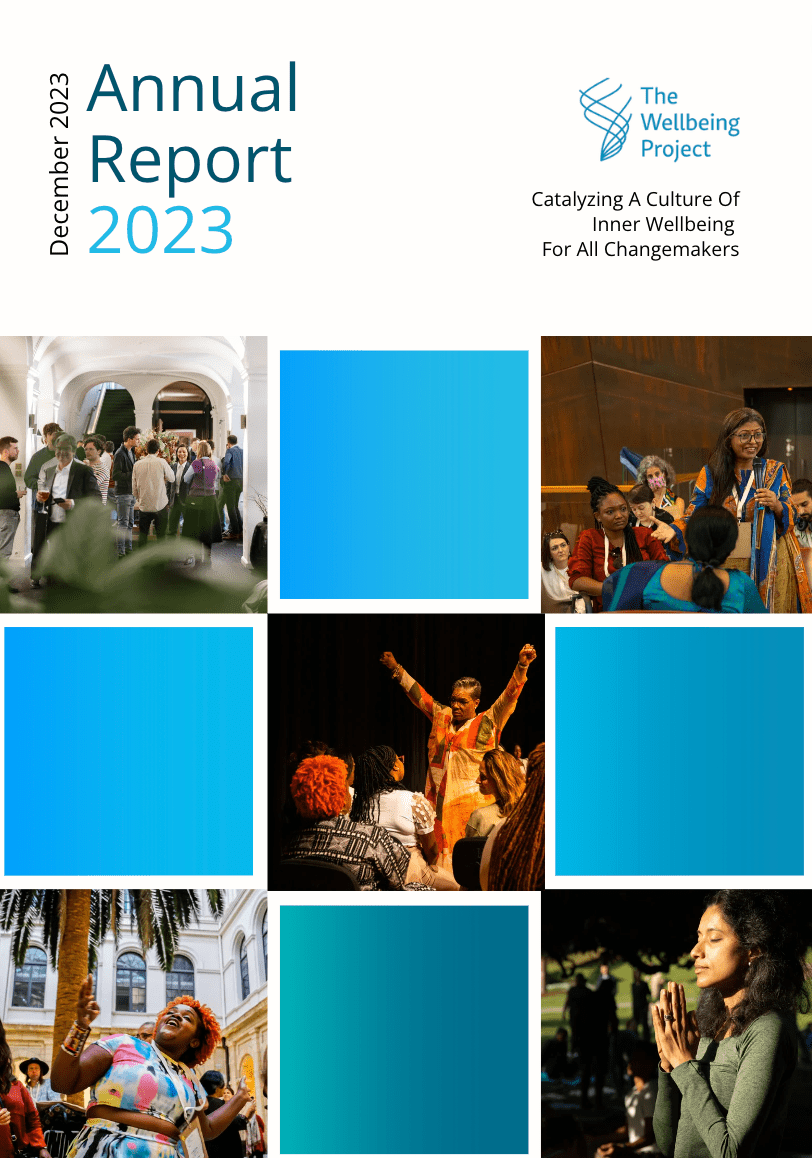
Impact Report 2023
Catalyzing a Culture of Inner Wellbeing for all Changemakers
Our work is guided by the core belief that the impact of any social or environmental change movement depends inherently on the wellbeing of the individuals and organisations within those movements. At a time of extraordinary change, The Wellbeing Project inspires those individuals and organisations to offer bold solutions to meet cascading, interconnected crises.
Read our 2023 annual infographic report to find out how together, we’re transforming optimism into action.
[mk_button dimension=”flat” size=”medium” url=”https://wellbeing-project.org/wp-content/uploads/2023/12/impact-report-2023.pdf” bg_color=”#0190bb”]DOWNLOAD REPORT[/mk_button]
[mk_padding_divider]
Cultivating a Thriving Inner Landscape Where Our Potential Can Bloom: 7 Learnings on How Mental Health Helps Achieve Social Change and PeacebuildingCultivating a Thriving Inner Landscape Where Our Potential Can Bloom: 7 Learnings on How Mental Health Helps Achieve Social Change and Peacebuilding
Growing up in Colombia, a country with an armed conflict, filled with bombings, massacres, and displacement, I always felt the need to heal our wounds of violence and work towards the construction of peace. Fundación Mi Sangre, co-founded with songwriter and singer Juanes, has been my primary vehicle for pursuing this purpose. Since 2006, Mi Sangre has played a pivotal role in fostering systemic cultural change in Colombia by involving youth and the actors surrounding them as key contributors to personal, community, and systemic transformation. This model equips participants with life, leadership, and entrepreneurial skills, empowering them to co-create positive changes in their communities, including solutions towards peace.
Our work encompasses a multifaceted vision of leadership, emphasizing the development of both individual and collective skills. It involves nurturing awareness, empathy, critical thinking, and curiosity while fostering collaboration. We address the challenges young people face due to living in impoverished and violent environments, providing comprehensive mental health support as a valuable resource for personal and collective transformation. With this emphasis on inner work, mental health, and wellbeing, we have seen positive results not only in our participants’ lives but in the systems all around us.
From more than 15 years of service to young people in Colombia, here are some of the lessons from our journey that have now become integral to our work.
1. We can support the individual through the collective.
In dealing with trauma and other mental health challenges, some specific cases require individual psychosocial support. However, our organization and country lack the resources to provide it individually at scale. Therefore, we have integrated mental health skills into leadership programs, to offer support in a collective setting while integrating a preventive approach. These programs blend self-discovery and introspection, with safe spaces, fostering social connections and a sense of belonging. The mental health dimension of our leadership programs holds a special place in the hearts of our participants. From our retreats, I recall with emotion their warm hugs, the tears of healing they shed, and the laughter that set their spirits free, all within the safe space we helped create for them.
2. Holistic wellbeing – connecting mind, heart, body, and spirit – is essential.
Our programs prioritize a holistic approach encompassing the mind, heart, body, and spirit. Engaging the mind fosters critical thinking, self-awareness, and informed decision-making. Emotional aspects, represented by the heart, nurture empathy and meaningful relationships. Physical well-being, supported by the body, ensures energy and vitality, offering valuable wisdom through a strong mind-body connection. Nurturing the spirit, which encompasses purpose and resilience, provides inner strength to face challenges. Collectively, these dimensions empower individuals to lead authentically, while achieving significant change. Our young participants have successfully created more than 1,800 change initiatives, achieving profound systemic transformations in areas such as violence prevention, reconciliation, gender equity, migrants’ inclusion, and prevention of forced recruitment to armed groups.
3. The creative arts and nature are our biggest allies.
Creative arts and nature are central to our programs. We offer creative outlets like painting, music, and writing to serve as therapeutic outlets, hellping to alleviate stress, anxiety, and depression. Art encourages mindfulness, fostering social connections and deep interactions. Simultaneously, nature provides purpose and tranquility and teaches the vital concepts of oneness and interconnection. Whether it’s a simple walk in the park, incorporating plants, or outdoor experiences in natural settings, these holistic approaches significantly enhance our program’s effectiveness. My heart fills with gratitude when I remember a participant who shared that she had discovered the wisest counselor in nature and had never received such profound guidance from anyone else.

Credit: Fundación Mi Sangre/Alejandro Bonnells

Credit: Fundación Mi Sangre/Alejandro Bonnells
“My heart fills with gratitude when I remember a participant who shared that she had discovered the wisest counselor in nature and had never received such profound guidance from anyone else.”
4. Mental health and wellbeing have to be cultivated.
From our community engagement, it is clear to us that mental health and wellbeing are not static conditions; they are cultivated over time through a combination of self-awareness, self-care, and positive life choices. To help our communities make these choices, we have developed several strategies, including an open-source library with tools and resources, along with trainer approaches and curriculums for parents and educators, on how to develop 17 different holistic leadership skills. To our surprise, this library, originally created for our team, has more than 2,500 visitors per month, demonstrating its regular use. We also don’t limit our mental health support to our participants: since the pandemic, our full team holds weekly online meetings to share various practices, encouraging us to lead by example and embody the change we want to be in our communities.
5. We must shift paradigms around mental health.
Transforming mental health paradigms is a crucial piece to this puzzle, given historical stigma that discourages those who are struggling from seeking support. To help change this dynamic, we have launched grassroots and national campaigns at Mi Sangre to normalize mental health discussions, emphasizing the importance of open, empathetic, and non-judgmental conversations. Recognizing that change starts at the individual and community levels, we are committed to creating tailored approaches to mental health, considering differences in ethnicity, gender, and age while incorporating local wisdom. We also seek to expand the dialogue on mental health to include wider audiences: inspired by the Wellbeing Summit for Social Change in Bilbao, we co-created the Wellbeing Summit Bogotá in September 2023. Mental health was a central topic at this event, which convened changemakers from the social change, business, academic, and public sectors. We aspire to extend this initiative to other Latin American cities, further advancing this crucial agenda for mental health.


An example of posters co-designed with local communities, written in Nasa Yuwe, the language indigenous communities of Toribio, Norte del Cauca, Colombia, with an invitation to reach out to mental health support services. Literal translation: “Weaving the good life. Mental health is harmony, source of inspiration and wisdom”. Credit: Fundación Mi Sangre/Alejandro Bonnells
6. Our personal journeys influence our professional work
Leading Mi Sangre has been a profoundly personal journey.My pursuit of inner growth and wellbeing commenced 18 years ago after facing burnout during my first venture. However, this journey evolved recently when I developed a deeper understanding of trauma’s impact on my work, through participation in the Inner Development Program by The Wellbeing Project. In a retreat with fellow change agents, I was transported back to a poignant childhood memory. I overheard the tragic fate of our neighbors, the parents of children my age who were kidnapped and brutally murdered. The re-emergence of this memory unleashed profound emotions, revealing the lasting impact it had on me. This experience unveiled the roots of certain unhealthy patterns in my entrepreneurial drive – a fear of losing what I cherish, an unconscious drive to do everything to survive and protect my loved ones, and a limiting belief that I must accomplish everything now because tomorrow is uncertain. I have undergone profound transformations as a result. When leaders embark on deep explorations of their inner selves, a much deeper layer of meaning emerges about who we are, what we do, how we pursue it, and, more importantly, how we want to pursue it. I have witnessed numerous stories of leaders similarly elevating their modes of operation (and impact!) by embarking on journeys of inner work.
7. Inner work can help heal systems.
In the pursuit of positive social change and lasting peace, inner work stands as a pivotal force that transcends individual growth to mend the very systems that have been fractured by violence and turmoil. The power of inner work is not confined to self-discovery and personal development; it extends to our collective consciousness and societal structures. Mi Sangre’s work involves weaving ecosystems, bringing together a wide array of participants from the public, private, and third sectors – sometimes even including former enemies and victims – to co-create solutions. Through our methodologies, we have witnessed the potential to transcend differences, hate, and fear in order to act collectively towards peace. By delving into the depths of our inner selves, we unearth the empathy, resilience, and wisdom required to reshape these systems.
“By delving into the depths of our inner selves, we unearth the empathy, resilience, and wisdom required to reshape these systems.”
Both through my work and personal experience, I’ve learned to embrace pain and struggles as inherent aspects of life. However, I’ve also seen the potential for leading a life filled with profound meaning, even in the face of persistent challenges. Equipping leaders with the skills to address trauma, support their mental health, and enable wellbeing is essential. In doing so, we are able to help them cultivate resilience, enabling them to reach their highest human potential, foster healthy relationships, and serve life with freedom and joy.
Looking back at the dream Juares and I had 16 years ago – working towards peace – I am convinced that including inner work in our systemic approach has been pivotal in catalyzing extraordinary leadership. Without it, we may have never been able to advance the reconstruction of our social fabric, influence decision-makers, and help heal systems that impact over 2 million people who have undergone profound transformations toward peace-building and social change. I invite you to explore how mental health, healing, and inner work may transform your work in social change – with a thriving inner landscape, there’s no limit for our how our potential can bloom.
About the authorAbout the author

Meet Catalina Cock Duque
Catalina Cock Duque, a seasoned catalyst for systemic change with over 25 years of experience, is a passionate leader in sustainable development, peace-building, and social impact. Distinguished as a Young Global Leader by the World Economic Forum and recognized by Silla Vacía in Colombia, she co-founded Fundación Mi Sangre, impacting over 2 million people in Colombia. As a Co-Founder of Oro Verde and the Alliance for Responsible Mining, Catalina played a pivotal role in establishing the first global certification for artisanal gold mining, expanding its reach to over 10 countries. She holds a BA from the University of Maryland and a Master’s from the London School of Economics, complemented by executive courses in leadership and innovation from top institutions worldwide.
Hear from Catalina's experience on taking part of The Wellbeing Summit Bogotá: Hear from Catalina's experience on taking part of The Wellbeing Summit Bogotá:

Defenders’ Wellbeing Collective
The Defenders’ Wellbeing Collective holds a space for leaders of grassroots, community, and survivor-led human rights organizations to reflect, experiment, share, and learn together about how best to support greater wellbeing and resilience within their organizations.
The mission of the Defenders’ Wellbeing Collective (DWC) is to understand the impact of human rights work on people who are from or directly working with communities to address human rights around the world.
The DWC has garnered an overwhelming response from human rights defenders worldwide. The remarkable interest demonstrates the urgent need for wellbeing support among human rights defenders and highlights the potential of the DWC to make a transformative impact on the field.
The program started in April 2023, the DWC is a two-year program that provides a space for human rights defenders to connect, learn, and strengthen their wellbeing practices, with virtual meetings and workshops every two months. The DWC plans to produce an internal work report, a survey of wellbeing on human rights defenders and a collection of reflections and shorter pieces of information for the overall public.
The Wellbeing Project co-created the DWC in collaboration with the Human Rights Resilience Project. The Wellbeing Project supports the work of the DWC in an administrative and advisory way.


LEVERAGING THE EVIDENCE ON THE RELATIONSHIP BETWEEN TEACHER AND STUDENT WELL-BEING IN LEARNING AND TEACHING:
A Scoping Review and Educator and Student Interviews
By Kimberly A. Schonert-Reichl, Denise Buote, Rebecca Baelen, Joshua Lovett, Maryam Al-Khalaf, Kay Thursby Bourke, Claire Galloway, Aynsley Parker & Ahmed Baghdady
The crisis of children’s mental health and rising disparities in educational outcomes have become global concerns, particularly due to the surge in mental health challenges among children and youth attributed to the COVID-19 pandemic and other global events that have caused disruptions to student learning and social and emotional wellbeing. Alongside the declines in the well-being of children and youth have been concomitant challenges for the teaching profession leading to discernible increases in teacher stress and burnout, potentially causing teacher shortages worldwide. In light of these concerning trends in the wellbeing of children and teachers, research examining the relationship between teacher and student well-being in the context of learning and teaching is profoundly needed not only to advance science and theory but to also to inform the design and implementation of programs and practices that allow for the creation of learning environments in which both teachers and students can thrive and flourish and reach their greatest potential.
In this extensive report, we present findings from two interrelated research studies that focused explicitly on exploring the relationship between teacher and student well-being in learning and teaching — a topic for which many questions remain. The aim of our research is to offer a deeper understanding of these relationships in order to provide valuable insights for educators, policymakers, and other stakeholders who share an investment in finding ways to improve educational experiences and opportunities for students both in the present and in the future.
At the Learning Planet Festival Watch Report Presentation
Join us as a Teacher Wellbeing PLC Member! Join us as a Teacher Wellbeing PLC Member!
The Teacher Wellbeing Professional Learning Community (TW PLC) is co-created by the World Innovation Summit for Education (WISE), an initiative of Qatar Foundation for Education, Science and Community Development, and the Wellbeing Project which is co-created with Ashoka, Georgetown University, Impact Hub, Porticus, Skoll Foundation and Synergos.
TW PLC is a group of members representing several sectors including non-profit, government, philanthropy, and academia. TW PLC aims to be a global learning community of professionals interested in teacher wellbeing and engaged in efforts to promote and support the wellbeing of teachers at the school, district, and system levels. Members of the community will include researchers and scholars, leaders and policymakers, trainers and professional coaches, and school principals and teachers who are engaged in teacher and curriculum development, assessment, action research and other school-based activities. LEARN MORE.
Exploring Art, Teraanga, and Social Change With Partcours at the Wellbeing Summit Dakar-ThièsExploring Art, Teraanga, and Social Change With Partcours at the Wellbeing Summit Dakar-Thiès
Learn about the upcoming collaboration between the Wellbeing Summit Dakar-Thiès host, Tostan, and renowned Senegalese art festival, Partcours.
In the heart of West Africa, where the vibrant culture and traditions of Senegal meet the challenges of a rapidly changing world, an extraordinary event is set to unfold: the Wellbeing Summit Dakar-Thiès, hosted by Tostan in partnership with The Wellbeing Project, promises to be a source of hope and inspiration for social change across the continent. At the core of the first Regional Wellbeing Summit in Africa will be a collaboration with Partcours, one of Senegal’s leading contemporary arts festivals. In the 12th edition of this renowned event, a new exhibition, “Yoonu ci biir (The Inner Pathway)”, will explore stories of inner journeys towards wellbeing through the eyes of local artists.
Wellbeing in a Changing World
In a world grappling with unprecedented challenges, the concept of wellbeing takes on a profound significance. The creation of art can be an act of hope; an expression of joy, anger, celebration. Art can provoke us to take action, move us to tears or laughter, and the creative process itself can be integral to our wellbeing.
The Wellbeing Summit Dakar-Thiès is an African-led, African-based initiative, bringing together local, national, and regional leaders. At the heart of this summit is the idea of Teraanga, a cultural concept rooted in Senegal. It reflects the belief that we are all interconnected and interdependent. What affects one individual or community has a ripple effect, impacting everyone. This concept will be reflected throughout the Summit through a dedicated space for discussion and action centred on wellbeing in the African context.
Teraanga reflects the belief that we are all interconnected and interdependent. What affects one individual or community has a ripple effect, impacting everyone.
An integral part of this discussion is the critical role of the arts in fostering creativity, self-expression, and wellbeing in diverse African communities. Believing in The Wellbeing Project’s motto – that wellbeing inspires welldoing – the Summit will explore the arts as a key tool for discovering and unlocking opportunities for social change.

The Arts for Wellbeing: Collaboration with Partcours
For this transformative summit, Partcours has teamed together with Tostan to curate an immersive art experience exploring the concept of wellbeing. The exhibition, “Yoonu ci biir (The Inner Pathway),” will feature the work of two remarkable local artists, Fatim Soumaré and Omar Diouf (Yafane), who have taken unique paths to find their creative practice and viewpoints on wellbeing.
“Art allows me to express, without constraints, my hopes of connecting with our ancestral practices and oral traditions. My works not only reflect cultures inherent in African craftsmanship; they also subscribe to an interdisciplinary dialogue. They bear witness to the progress and ingenuity of collective practices to develop and sustain social and economic activity. Through the thread-craft traditions of the women’s collective I created in 2021, I explore the traces of their existence to ensure the collective preservation of their material and immaterial memory.”
Fatim Soumaré is a Senegalese artist living in the Sine Saloum region who has a deep passion for textiles. She has preserved the ancestral African tradition of falè, the hand-spinning of organic, rain-fed cotton. Fatim’s art is not just a visual experience but a tactile and emotional one. Through her art and home textile brand, she employs a collective of 200 craftswomen, connecting them to their heritage and a source of livelihood.
“Art allows me to express, without constraints, my hopes of connecting with our ancestral practices and oral traditions. My works not only reflect cultures inherent in African craftsmanship; they also subscribe to an interdisciplinary dialogue.”
— Fatim Soumaré


Omar Diouf, also known as Yafane, is a self-taught artist from Mbour, Senegal. A farmer by day, his artistic universe is adorned with diverse and beautifully recycled materials, from shells to mirrors to plastic waste. He infuses his lived experiences in his artwork, bridging elements of sustainability and creativity in his creations.
“For me, art contributes a lot to my community. My creative knowledge and abilities are companions for both me and my community. Art contributes to our African cultural heritage and is an important legacy for the benefit of future generations.”
The art installations, thoughtfully created by these two artists, will be showcased at the Sococim Foundation Cultural Center in Rufisque, near Senegal’s capital, Dakar. The opening night will coincide with the Wellbeing Summit Dakar-Thiès, bringing together artistic expression and reflections on wellbeing from an African perspective.
“Art contributes to our African cultural heritage and is an important legacy for the benefit of future generations.”
— Omar Diouf (Yafane)
This collaboration is a unique opportunity to connect local changemakers, artists, and wellbeing practitioners from across Africa to share ideas and experience the profound impact art can have on wellbeing, and wellbeing on art.
As Partcours’ curator Mauro Petroni noted, “Our two featured artists’ inventions explore very different paths. However, both start from their own intimate lives and arrive at the same point.”
In Yafane’s work, he explained, we can see a forward journey from his roots. As a farmer, he lives in a field that is his space and his workshop. Completely self-taught, he accumulates all sorts of things and arranges them to achieve an expression of skilful simplicity. This allows him to go wherever and land wherever – totally uninhibited.
Meanwhile, in Fatim’s pieces, we can see the reverse as she journeys towards her origins. Having set off from another world, she comes to the collective source to rediscover the simple wisdom of tradition. From there, she continues a journey without contradiction into the poetics of woven thread and the social lives of women artisans. She takes us with her, with her lightness and her laughter.
Petroni concluded, “At some point in history, thanks to wellbeing, they crossed paths. Fatim and Yafane will be our guides and our examples, teaching us the understanding and expression of their human experience.”
Fatim and Yafane’s creations will be one part of the Wellbeing Summit Dakar-Thiès’ larger programme, which will feature local and regional arts and music to help foster self-reflection and shared connection. West African song and dance, contemporary art installations, and theatre will be woven into the Summit – inspiring a unique individual experience that can lead to collective action and wellbeing for all.
“Yoonu ci biir (The Inner Pathway)” will open on Thursday, 30th November at 17:30 at the Sococim Foundation Cultural Centre, where attendees can meet the artists who will participate in a dialogue on art and wellbeing.
Those in Senegal can enjoy the exhibition from 30th November to 31st December 2023 as part of the collaboration between Partcours and the Wellbeing Summit Dakar-Thiès.
Celebrating ShōkakkōCelebrating Shōkakkō
The Art of Life’s Little Joys
TheMerode’s latest exhibition invites happiness in all its forms to the Wellbeing Summit Brussels
Can the answer to one of life’s greatest questions – what is happiness? – be found in the smallest minutiae of daily life? Shōkakkō, the latest art exhibition at TheMerode club in Brussels, invites us to explore this idea by celebrating the serendipity that comes from cherishing the small and simple. We are thrilled that Shōkakkō will be at the heart of the first Regional Wellbeing Summit in Europe, which TheMerode will host from 16th-17th November, where themes of joy, mindfulness, and wellbeing will converge. Following the success of our Global Summit in 2022, the Wellbeing Summit Brussels will continue building the wellbeing for social change movement by embracing a central theme – “moving from ego to eco” – and embarking on a transformative, multidimensional journey to connect our individual wellbeing with that of our communities and the planet, envisioning a holistic approach to social transformation.
Coined by best-selling author Haruki Murakami, shōkakkō is a Japanese term that captures the essence of small joys — the tiny moments of delight that, while perhaps found in the mundane and ordinary, are foundational steps in our path to happiness. In small sensory experiences and fleeting seconds of feeling, you notice tiny sources of happiness all around you. You might enjoy noticing them by yourself; you light share a smile or a laugh with others as you do so. These are shōkakkō: your humble, quiet, and little pieces of joy.
小確幸 (shōkakkō) • noun • small but certain happiness

The Shōkakkō exhibition is one that, in representing a community’s views on happiness, puts collective thinking at the heart of contemplations on happiness. The exhibition speaks to the fundamentals of human relationships, offering a step back from individuality in order to focus on the collective and the joys that come from feelings of belonging. With the Wellbeing Summit Brussels’ theme in mind – moving “from ego to eco” – the exhibition seems to suggest that happiness and, to a larger extent, wellbeing, can be found in the sharing of experiences and contemplating life’s joys with others.

For the exhibition Shōkakkō, TheMerode asked its members their definition of happiness and, embracing the emotional, experiential diversity of their responses, curated a colourful selection of works from 54 artists that embody members’ little joys. Visitors are able to wander around TheMerode and enjoy works from international artists offering views of happiness through a kaleidoscopic lens. As TheMerode’s curator Emmanuelle Indekeu said, “This exhibition doesn’t aspire to redefine happiness, but rather to collectively explore the myriad manifestations of happiness in our lives.”
Consider this art: to capture the epiphanies that heighten our sensitivity to the sheer act of being alive.”
– Patrick Chamoiseau
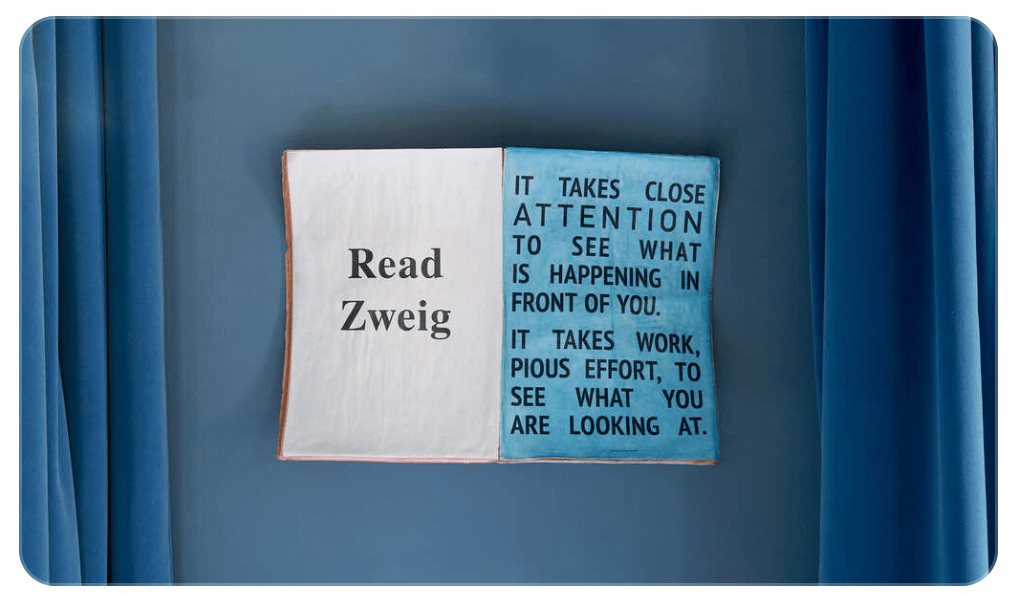
As we pursue wellbeing in our work to drive social change, remembering to notice and cherish our own shōkakkō is a beautiful and helpful practice. By slowing down, being mindful, and keeping an eye on the little things in life, we can invite a certain quietude, peace, and happiness into our hearts. We can remind ourselves of the small but mighty power of presence while, in our work as changemakers, we often find ourselves confronting some of life’s biggest challenges.
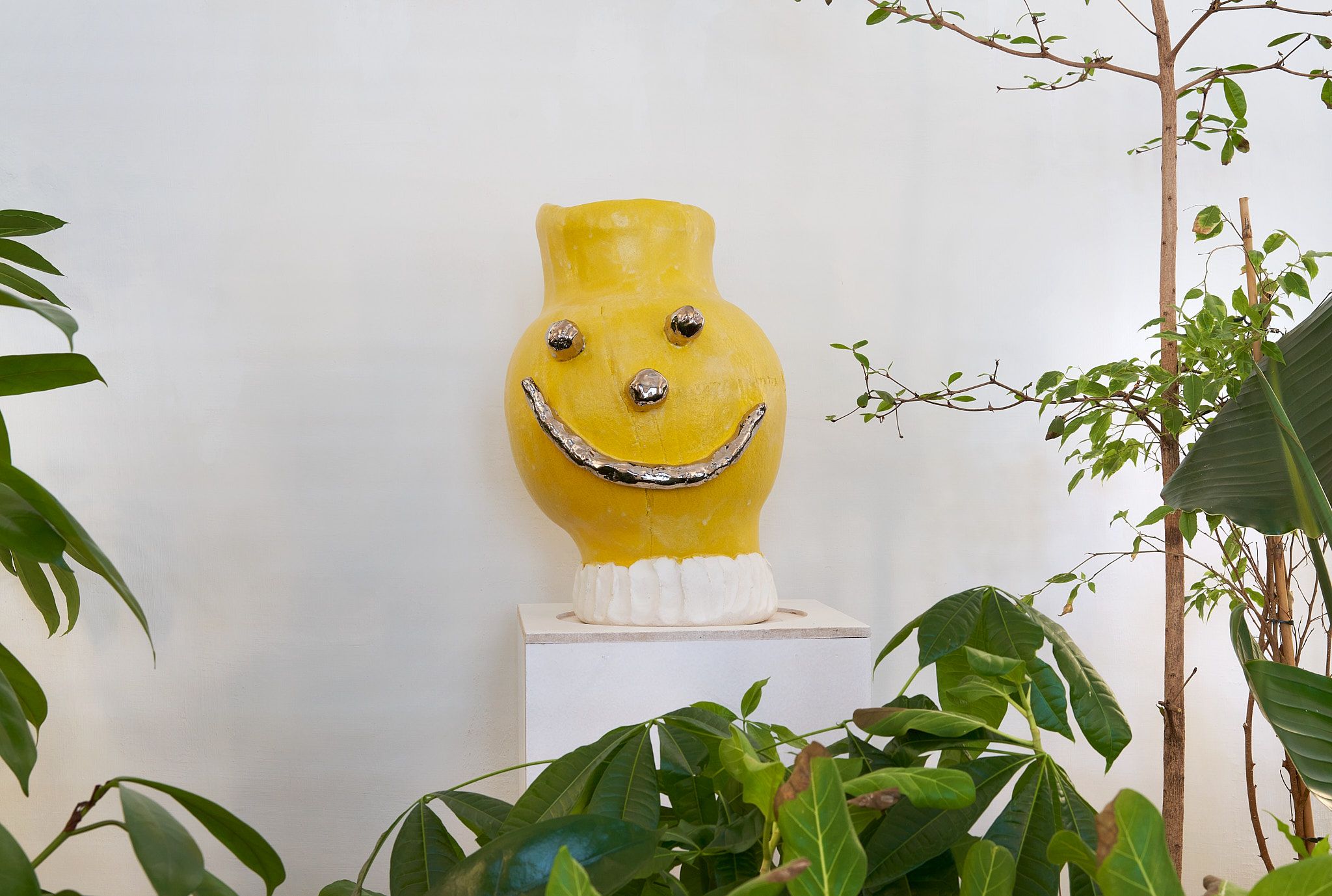
While European readers can enjoy Shōkakkō in-person at TheMerode during the Wellbeing Summit Brussels, the beauty of shōkakkō is its universal presence in all of our lives. To help inspire your own celebration of shōkakkō, we asked members of our community to reflect on the happiness in their own lives. Here’s what they said:
Happiness is…
“Made up of small, simple things that can affect each of us with our own sensitivity. One of the greatest joys for me is my freedom of thought and movement.”
“Looking at the sky first thing in the morning and mentally saying good morning to the world (and sometimes also saying it out loud).”
“A piece of chocolate in the afternoon”.
“Silence and chirps of birds in my 9th-floor home with busy Mexico City hustling below.”
“A good meal and a good drink shared with good friends.”

“My kids’ laughter.”
“I don’t know what happiness is, but I know what makes me happy and that’s more than enough.”
“Happiness is stronger when shared. Let’s embrace the happiness that comes from others, nurture sharing with our loved ones, celebrate the small wonders of life, and seek the spark of happiness in every moment.”
“My job: to convey the emotion of my thoughts to the customer through a dish.”
“The smell of my kitchen when I’m baking.”
“Tasting something I ate as a child and loved. The memories come flooding back.”

“When you release the expectations of others you then create your own happiness.”
“Passing by the garden at the entrance to my office office and being in awe by with the flowers and smells.”
“Watering my plants and seeing the sun filter into my apartment.”
“Watching my dog get excited about something.”
“My family. I had the incredible opportunity to grow up in a large family, and they’re my joy. All of them, in so many different ways, with so many different characters, in arguments, in laughter and in moments of sorrow.”
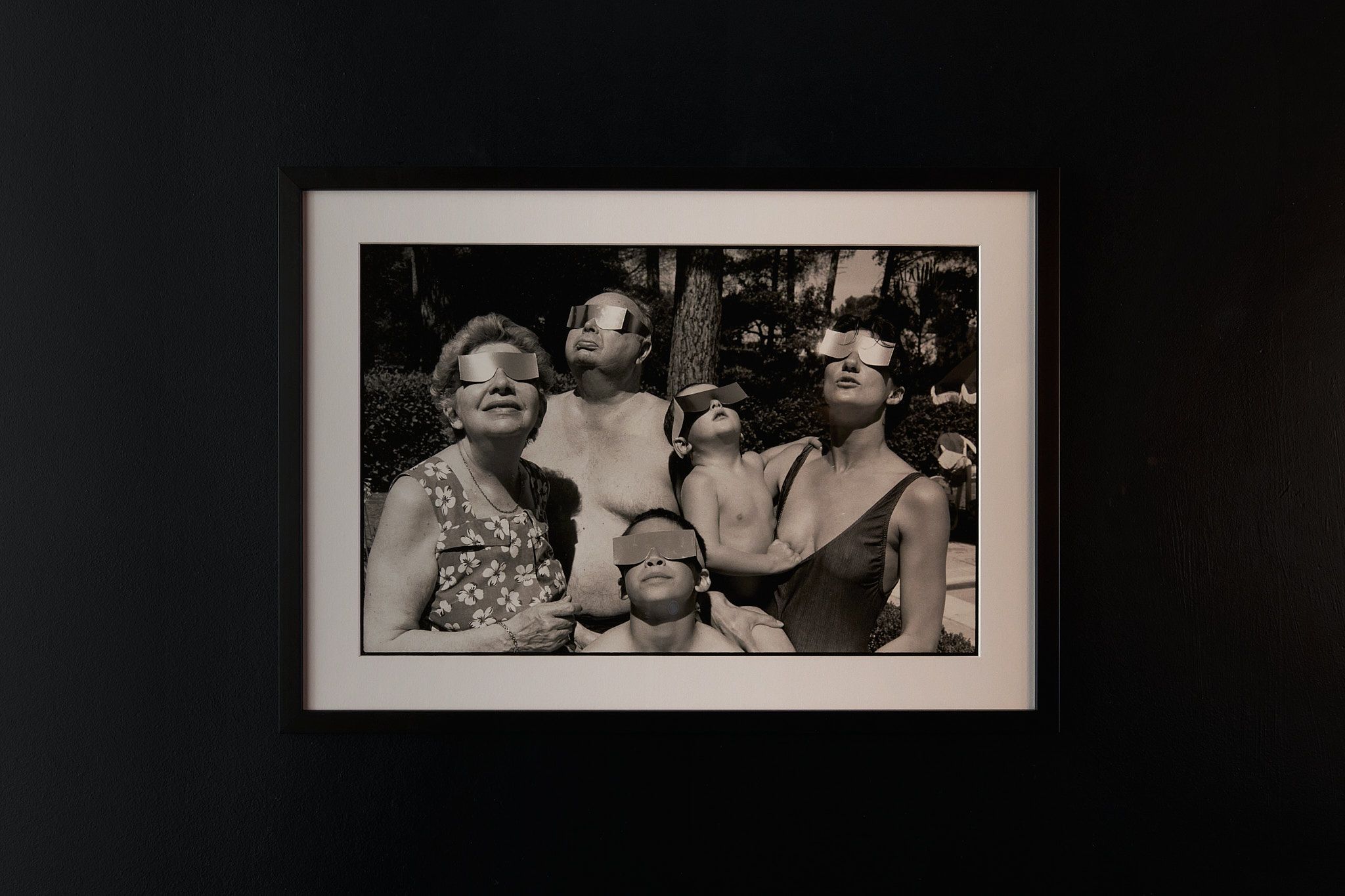
“Learning, sharing, helping each other and meeting new people.”
“Giving a hug to my kids in the morning or any time of the day.”
“Calm evenings of reading while my partner practices piano.”
“Tranquil night walks in the neighborhood park after dinner.”
“Opening the blinds every morning to let daylight into my home. It feels as if the world is welcoming me into life for one more day.”
“Closing the blinds and putting on my favorite show before bed. I made it through another day and I’m in my safe place. It’s time to rest.”

Enjoy the rest of TheMerode’s exhibition Shōkakkō at the Wellbeing Summit Brussels (16-17th November 2023).
Wellbeing in West Africa: How We Gather TogetherWellbeing in West Africa: How We Gather Together
Guest post by:
Carina Ndiaye, Chief Partnerships Office, Tostan
In Senegal, we call it Teraanga. It stands for openness and sharing, meaning: “we invite you to come in.” This cultural norm is present throughout the region and across the continent. Words like Ubuntu in southern Africa portray acknowledgment, respect, and coexistence. In Senegal, through Teraanga, the concept behind the Hindi word Namaste (meaning: “the light in me sees the light in you”) is extended and reinforced to say, “what is mine is yours.” This applies not only materialistically but also to the earth, the sun, the sea, and the unseen. From visitor to member, from transitory to influenced, in our culture, the ‘you’ never stands alone. What affects you also affects me and my community, and community includes anyone who walks our way and crosses our path.
As Tostan agreed to host the first African Wellbeing Summit, joining The Wellbeing Project and key partners hosting similar summits around the world, Teraanga has been a foundational concept for us. It is an entry point into the broader West African cultural systems that value people and their shared history and interconnectedness and that prioritize interdependence over independence.
Our upcoming African Regional Wellbeing Summit Dakar-Thiès 2023 reflects our dedication to embracing community-centered models that resonate with our core values. Locally-driven initiatives and capacity development for communities are critical paths forward, as our CEO Elena Bonometti has pointed out. But at the heart of our vision is Teraanga, where openness and sharing guide us in meeting the multifaceted challenges that our world faces. In Senegal, when challenges arise, a community gathering – referred to as a “pénc” in Wolof – is called to bring together the community for discussion. The Summit will be a globally-connected pénc, embodying the essence of African-based, African-led collaboration and growth in wellbeing. This is not just a “nice to have”; it is essential to our collective wellbeing and social cohesion.
There is a deep respect here for where people come from and for who and how they are. Many traditions create space for people to be seen, acknowledged, and recognized. Through greetings, names, joking, showing respect, and almost countless ways of engaging, we witness and reinforce one another. We see more clearly the threads interweaving our collective well-being. These traditions aren’t technical solutions or abstract topics; they are ways of meeting and gathering together, of creating spaces and openings where we can understand one another, share our perspectives and passions, and work better together.
With over 32 years of experience as a Senegal-based organization, welcoming partners from more than 50 countries far beyond Africa’s border, at our Tostan Training Center, we have come to understand that these ways of welcoming, these traditions for creating space, for seeing and being seen, can be powerful. As our global community seeks to find ways to support increased wellbeing in a context of increasing urgency and challenge, we hope our African Regional Wellbeing Summit Dakar-Thiès 2023 can contribute and share these ways of coming together.
Through our collaborative planning for the Summit, we have found some important themes to explore together. These include mental health, digital wellbeing, wellbeing in the workplace, and others. But the success of our conference won’t be limited to topics, action plans, or best practices. It will also depend on how people feel when they leave, how they can sustain connections, and whether they have found some new ways of inviting change into their lives, their organizations, their work, and our world.
About the African Regional Wellbeing Summit in Dakar and Thiès, Senegal
Join us for the first African Regional Wellbeing Summit in Dakar and Thiès, Senegal, hosted by Tostan from November 29th to December 1st, 2023.
The Summit will be an opportunity to engage in workshops, panels, and social moments to explore wellbeing, especially for those working in service for community-led development, from diverse African perspectives. Discover themes including mental health and its impacts on wellbeing, the role of religion, youth, and digital health.
Four Seasons Under One Sky: Arts as a Collective Approach to Creativity and Healing in South Africa Four Seasons Under One Sky: Arts as a Collective Approach to Creativity and Healing in South Africa
Guest post by:
Marlize Swanpoel
Co-Founder & Director, sp(i)eel arts therapies collective (Cape Town, South Africa)
sp(i)eel is an arts therapies collective (including drama, music, dance/movement, and art) of arts therapists, applied arts practitioners, and arts activists addressing intergenerational and complex trauma in South African communities. Over two centuries of colonialism and the oppressive regime of apartheid has left a nation grappling with systemic inequity and intergenerational trauma. Ongoing poverty and high incidences of violence and crime coupled with a dire lack of mental health services are contributing to complex and ongoing trauma, with more than a quarter of South Africans suffering from probable depression (Craig et al, 2022). This mental health crisis our country is facing is a systemic issue, not an individual one, and it needs a collective response. Our approach to mental health is culturally informed and sees people as each other’s greatest resource and source of support. As a result, our ultimate goal is to develop collective resilience that can affect social change.
Our name, spieel, is derived from two words that have different meanings in the Afrikaans language: “to play” or “mirror”. To “play and mirror” speaks to several reasons for our use of art as a healing tool. It refers to the function of the arts as a mirror to society for expression, reflection, and understanding. It also speaks to the therapeutic aspect of art therapies, where an art form is applied as a mirror to Self for exploration and understanding. Furthermore, it is through the playful nature of the arts that we can connect with our innate creativity.
It also speaks to the therapeutic aspect of art therapies, where an art form is applied as a mirror to Self for exploration and understanding.
In South Africa, access to therapeutic arts programmes is limited and not accessible to everyone. We aim to enable accessibility to the intentional use of various art forms to further have a positive impact on general health, wellbeing, development, and transformation for all.
Given our deep connection with the arts, our story and impacts can best be shared visually. This photo essay illustrates the journey of healing and wellbeing experienced through our Families and Collective Futures programme. It is a resilience-focused, trauma-informed programme that applies the arts and creativity to build psychosocial support systems. These systems are created through research (in collaboration with Brunel University), training, and the implementation of arts-based groups for children and their social circles.
The journey of this programme is presented within the frame of one of our core guiding metaphors: the four seasons. It represents the following. Firstly, just like the seasons, our mental health and wellbeing are not in a fixed state. We experience constant ups and downs. By accessing tools such as embodied awareness, reflexivity, and regulating skills, we can support ourselves and each other to navigate through these seasons of illness and health.
Secondly, this metaphor understands mental health and wellbeing in the context of the ecosystem. Communities are made up of people in different seasons of life. Collective resilience implies that the pressure to bounce back from hardship is not the sole responsibility of the individual. When one person suffers, it affects everyone. Everyone plays a role in collective health; as a collective, we are stronger together.
Collective resilience implies that the pressure to bounce back from hardship is not the sole responsibility of the individual. When one person suffers, it affects everyone.
Lastly, the seasons mirror people’s relationship with nature, and offer a platform to reflect on cultural and indigenous knowledge embracing nature as a source of healing.
We begin our journey in the season of (re)birth: Spring.
SPRING SPRING
Tending to the Soil So the Seedlings Can Thrive
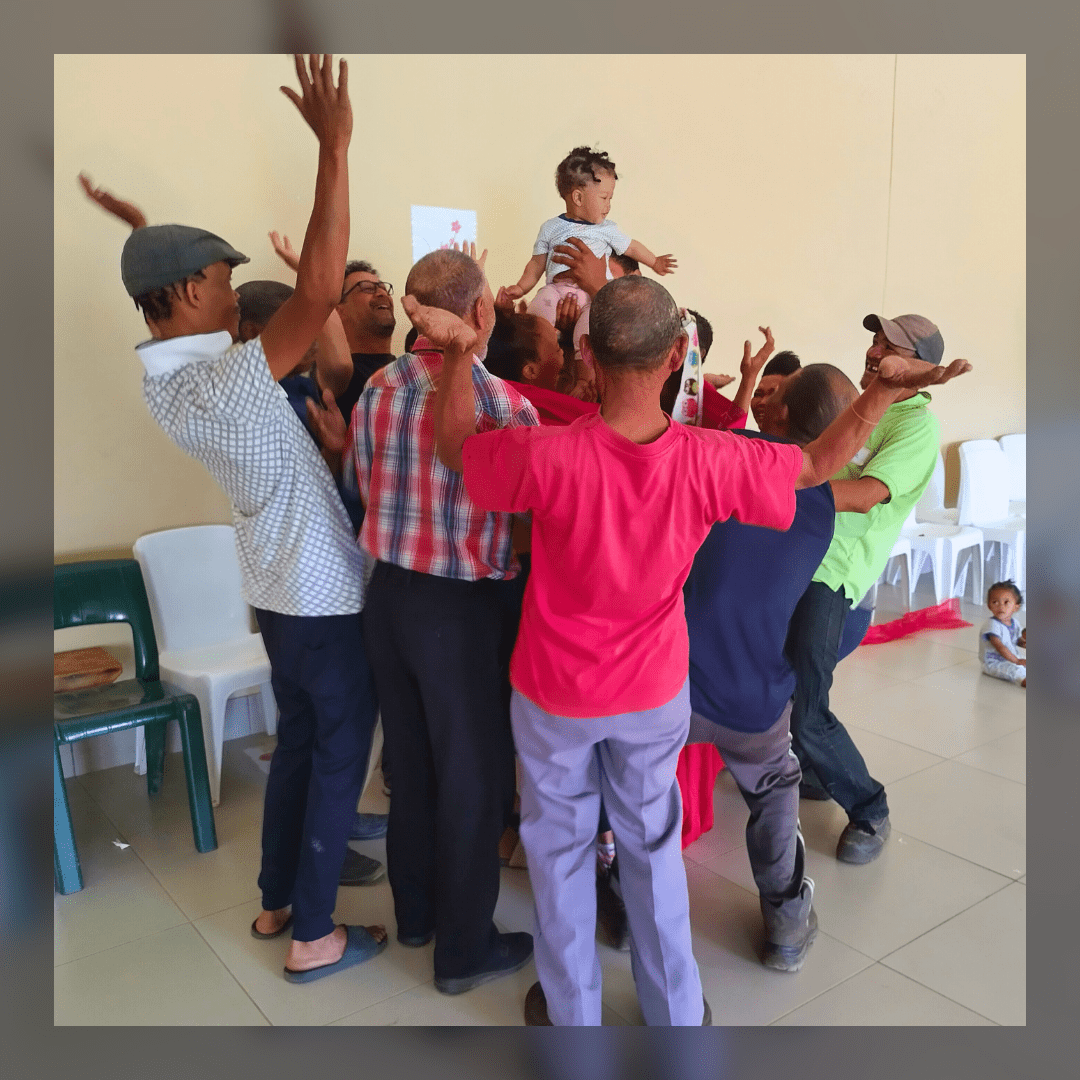
In a community workshop, participants create an embodied image of Spring. A healing-centered approach to intergenerational trauma in family systems involves the adults developing reflective and regulating skills to take care of their own mental health, so that they are better aware of unhelpful patterns of relating in their families and community.
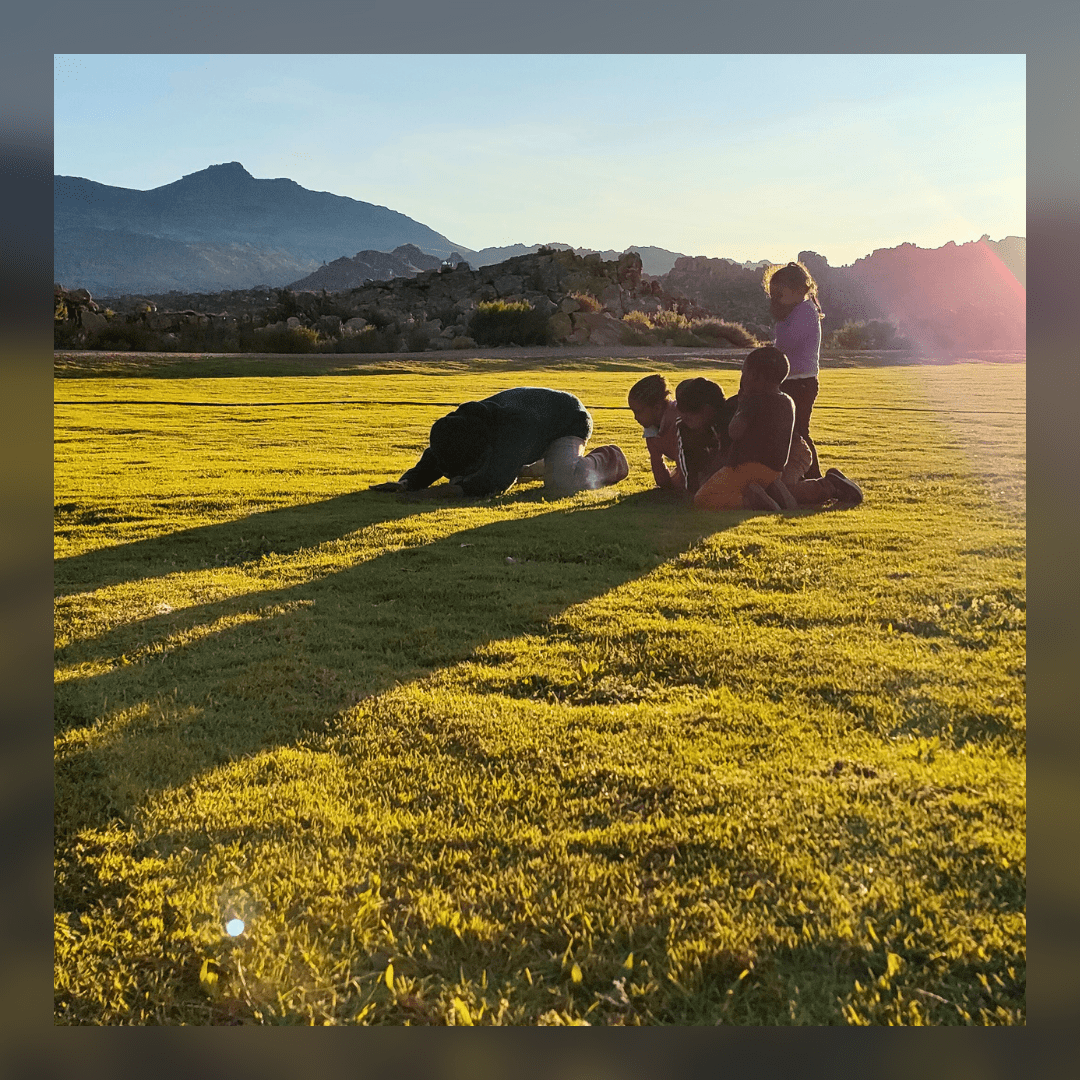
Arts activist Gershan Lombard facilitates a ritual of gratitude at the end of a community workshop, with the small children keeping a close and curious eye. Culturally-informed psychosocial practice includes honouring indigenous knowledge and spiritual practices of health and wellbeing to share this wisdom with the next generation.
Summer Summer
Young People’s Shining Stories

A group of young women share their story about Summer as a starting point to explore themes of health and wellbeing. It is vital to offer young people multiple ways to share their thoughts and feelings, as words are not always readily available to express their inner worlds. As one participant (grade 11, high school leaner) revealed to us:“You might have noticed that we are a generation that keeps to ourselves, and we don’t trust anyone with our feelings and our thoughts. Especially because we don’t know how to talk about our feelings and our thoughts. You have come to show us that we can also show you through our songs and through our dances how we feel and what we are thinking. And that is freedom.”

A young woman creates her “Glimmer Box”, a tool that supports participants to explore what resources are available to them to support their mental health and wellbeing. These include positive relationships, safe spaces, and activities that regulate their emotional states. Some of these are drawn, painted on stones, or represented by found objects in nature and placed in the box as tangible reminders of available support systems.
“You have come to show us that we can also show you through our songs and through our dances how we feel and what we are thinking. And that is freedom.”
Autumn Autumn
A Season of Trust and Letting Go

A couple rests back-to-back and connects with each other’s breath. Our embodied, trauma-informed practice is drawn from Stephen Porges’ Polyvagal Theory as a way to understand the autonomous nervous system’s responses. This helps us understand our reactions to triggers and to develop tools for regulating and finding safety and connection in the present moment. The couple shared afterwards: “My partner and I are having difficulties in our relationship. This workshop has given us the space to sit and just be with each other, to re-connect, and we were able to talk about things. This had a positive influence on our children and family life.”

In a workshop for mothers and daughters, mothers embody the support of a bridge, coming together to keep a girl above water. This workshop took place during a time of heavy flooding in the area in which some participants had lost their homes. This role-playing offered a way to express the traumatic experience: “The only way to keep safe is when we all look after each other’s children. We are not alone in this world, and your child is my child,” shared one mother. The embodied work where non-verbal communication is encouraged also supported bonding between mothers and daughters: “Girls don’t open up to parents, this exercise helped us to open up to each other,” said a young participant.
“We are not alone in this world, and your child is my child.”

A group embodies the word “women” in Circles of Support, one of our workshops for women. This workshop explores the female menstrual cycle as its four phases are linked with the four seasons, inviting conversations around menstrual and sexual health, menopause, and mental health and wellbeing. These circles are filled with generational knowledge, beauty, hope, and wisdom. One participant expressed her joy: “My experience was that I can be comfortable with myself as a woman. And I can express my feelings and accept my body. To be a woman is great!
Winter Winter
Embracing the Wisdom of the Elderly
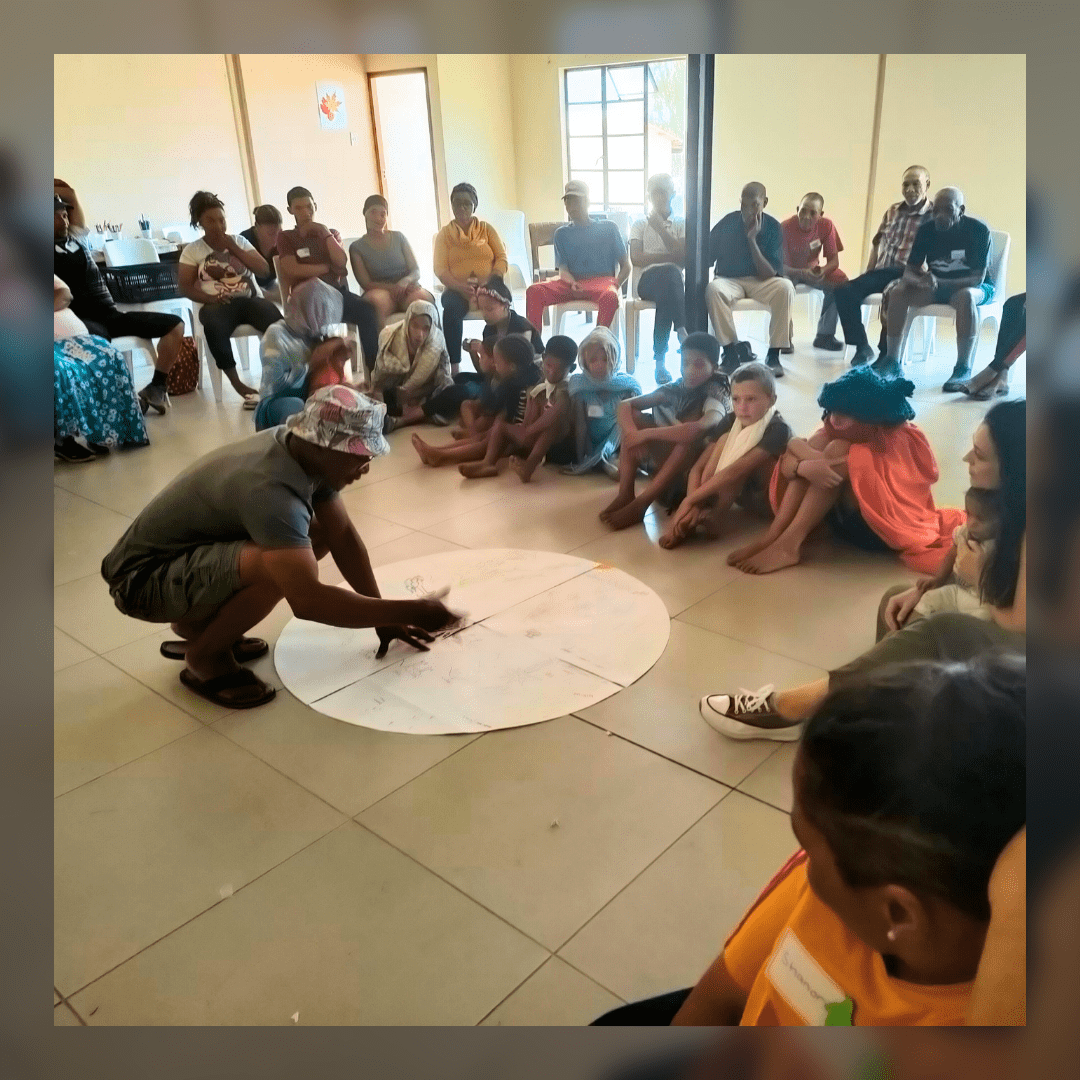
A whole community, including the elderly, adults, youth, and children, are enchanted by a storytelling circle. We witnessed a beautiful moment where the children sat and listened to the stories of the elderly, and asked them questions about the history of their community. Such events where the stories of the elderly are centralized, offer a means to narrate collective and cultural history to the next generation.

Elderly men create their own Glimmer Maps to identify their “glimmers”: small moments when we are in a place of connection or regulation, which cues our nervous system to feel safe or calm – the opposite of triggers. They are made by tracing a hand on paper, followed by a symbol of nature representing the Self drawn into the palm. Each finger represents a glimmer with prompts from nature, for example: air for breath, fire for warmth, love, comfort and rest, water for movement, and earth for grounding. Finally, we connect the glimmers to our community, and include the name of a person who makes us feel safe.
Concluding Concluding
One Cycle, Inspiring Another
A core element of the Families and Collective Futures programme is the creative methodology. One participant reflected that the manner in which we engaged with them has helped people to come out of their shell, as “ons mense neem nie maklik deel nie” (“our people do not engage easily”). To help ease our participants out of these shells, we understand several contributing factors help create a sacred and safe space where mental health and wellbeing can be addressed:
A scaffolded approach to introduce arts-based work;
The invitation to engage in any way that feels comfortable;
The knowledge that attendance is voluntary; and
The modeling of respect, tolerance, and kindness.
The above learnings speak to a healing-centered approach to trauma and essentially it is a message of hope. When we work within the ecosystem in a culturally-informed way, it creates space for innate and indigenous knowledge to be heard and received. As a result, when we understand that healing is available to everyone and happens in relation to each other, we can create circles of psychosocial support that are resilient enough to affect social change.
When we understand that healing is available to everyone and happens in relation to each other, we can create circles of psychosocial support that are resilient enough to affect social change.

We conclude this photo essay with a reflection of a participant on the theme of seasons and the image of a Glimmer Map, made by a young girl. “Every season produces something for the other season so that, in the end, nature can provide for us. Everything is a circle. And we are all part of the cycle.”
About The Author About The Author

Meet Marlize Swanepoel
Marlize Swanepoel is a Dramatherapist and the founding director of sp(i)eel arts therapies collective, an NPO that addresses intergenerational trauma and co-create community-based models of mental health care that are culturally informed and relevant to the South African context. She serves on the Secretariat of the South African National Arts Therapies Association (SANATA) and is a guest lecturer at the University of Cape Town. She is an enthusiastic advocate for the Arts for Health movement in South Africa that speaks to healthcare from a global South perspective. She loves being in spaces of learning, unlearning and dancing.