The Business of Giving Podcast The Business of Giving Podcast
``WHY INNER WELLBEING IS ESSENTIAL FOR ALL CHANGEMAKERS`` THE BUSINESS OF GIVING WITH DENVER FREDERICK ``WHY INNER WELLBEING IS ESSENTIAL FOR ALL CHANGEMAKERS`` THE BUSINESS OF GIVING WITH DENVER FREDERICK
Social activists have a disproportionately poor quality of life. Many struggle with depression, burnout, high divorce rates, and financial pressure. And while 75% of changemakers surveyed felt that looking after their wellbeing was very important, only 25% reported they actually did to a great extent.
The Wellbeing Project was created to change the culture of the field of social change to one welcoming of inner wellbeing, and to catalyze an infrastructure to support everyone working in the field. They believe that wellbeing inspires welldoing. And here to discuss this work with us is Aaron Pereira and Sandrine Woitrin, the project leads of The Wellbeing Project.
The Wellbeing Project Podcast The Wellbeing Project Podcast
Supporting Individual and Collective Wellbeing, with Dr. Anjhula Mya Singh Bais
Wellbeing Network Events Wellbeing Network Events
Upcoming Events Upcoming Events
Past Events Past Events
Global Summit on Dance Movement Therapy for Change – Reflections Global Summit on Dance Movement Therapy for Change – Reflections

By: Anubha Agarwal , Research & Learning Manager at The Wellbeing Project
Date: January 2023
Last month I had the pleasure to represent The Wellbeing Project at the Fourth Biennial Global Summit on Dance Movement Therapy for Change in the eclectic and colorful city of Jaipur, Rajasthan in India.
The two-day event was co-hosted by Kolkata Sanved – a non-profit organization based in India promoting holistic well-being through Dance Movement Therapy (DMT) and Center for Lifelong Learning (CLL), Tata Institute of Social Sciences – a unit of the leading public research university in India.
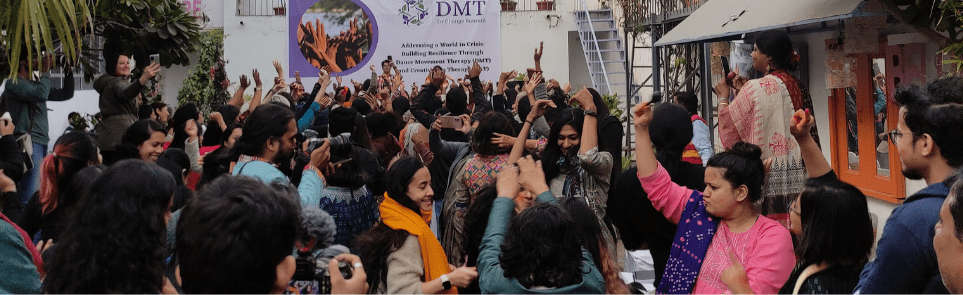
The fourth biennale held on January 12-13th , 2023 in Jaipur was focused on exploring the role of DMT and other creative expressions in building our collective resilience for navigating a world that seems to be at a heightened risk of diminished ecological health and well-being. The 2023 Fourth Biennale DMT for Change was attended by a diverse global audience comprising of development sector professionals, including DMT practitioners, Creative Art Therapy (CAT) practitioners, social scientists and public health experts.
With a colorful mix of experiential sessions, workshops, panel discussions and art installations, the Summit events wove together seamlessly in a rich tapestry. While ecological well-being of planet Earth and the looming danger of the climate crisis was the dominant theme at the Summit, the event was peppered with participatory sessions and workshops employing music, visual arts and storytelling to express individual reflections.
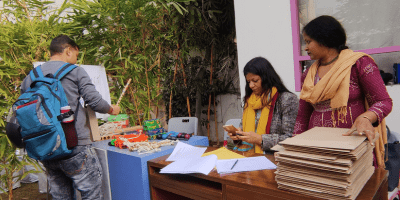
That artistic underlying theme at the Summit was evident, when at the time of registration, each Summit attendee was offered an option to choose a handheld musical instrument ( displayed below ). I found it amusing to briefly fiddle with the wide range of percussion instruments and select one, even though the intended use was not entirely clear to me. It became clear in time as the attendees enthusiastically sounded the percussion tools to endorse a speaker or an idea, infusing fresh energy and cheerfulness into the Summit events in the process.

Before the Summit, I was unfamiliar with the role of dance movement therapy as a psycho-therapeutic healing practice. Even though it is commonly known that dancing releases mood-enhancing hormones in humans, I was curious to understand how DMT was different in terms of providing subsistence to trauma victims and survivors of violence in our communities.
While I was quite thrilled to avail an opportunity to experience DMT through an experiential workshop at the Summit, I was also mindful not to participate in the workshop with the possibly unfair expectation to fully imbibe the therapeutic benefits of dance movement therapy. Considering DMT is a therapy, it might need longer duration support and intervention, than joining in one hour and a half long session. Having personally experienced the de-stressing effect of many dance forms in the past despite having two left feet, I was looking forward to experiencing DMT first hand.
During the workshop, free flowing movements that came naturally to each one of us were encouraged, the underlying thought being that DMT is a safe space where in every individual is free to express themselves in the way they want. In line with this tenet, an unfamiliar yet intriguing section of the workshop encouraged each participant to imagine their physical body as a paint brush and to use their limbs and torso to paint a limitless, imaginary canvas. Shifting my mental lens to think of my physical form as a paint-brush took some getting used to but eventually the infectious energy of the workshop cohort took over.
I admit to feeling mentally relaxed and exhilarated post-workshop but still curious to understand how DMT could potentially serve as an antidote to counteract violence in our vulnerable communities. In a country like India, society norms can be quite restrictive of womens’ movement outside the society- or family-ordained ‘safe’ physical spaces, so I felt it would have been insightful to know how the DMT practice can support individuals in freely expressing their possibly repressed agency and take better care of their holistic well-being. In retrospect, I think hearing narratives from DMT practitioners who use DMT as a tool to navigate everyday threats to their physical and mental well-being, would have been of immense value in understanding the practice better.
It is entirely possible that such narratives may have already been shared in the past Summit editions, but as a first-time participant, I missed the absence of such narratives. I did get to interact with a couple of DMT practitioners who mentioned that the practice helps them cope with everyday stress and shift the lens on how they view their lives.
[mk_padding_divider size=”20″]

One of the key learnings for me during the Summit was the reinforcement that approaches to enhance one’s well-being are quite individualized. Availing the opportunities to experience different expressive art forms at the Summit was a constant reminder that there is no one-size-fits-all approach to well-being. An art therapy that might have a profound impact on one, might fail to put a dent on another individual’s well-being.
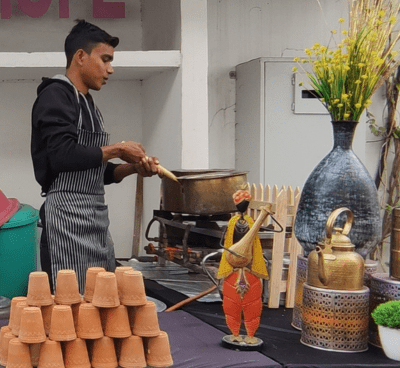
There is also the question of lack of funding to support well-being – the proverbial elephant in the room. However, until the world decided to acknowledge the presence of the aforementioned elephant and fully awaken to the mental health crisis we are in, one of the speakers at the Summit offered a slightly simpler solution to cope, “Art therapy is expensive… a good place to start is to start noticing what art tools you have easy access to at home such as fallen leaves, spices or other readily accessible elements of nature often overlooked. Art material could be taken from elements that are part of an individual’s environment or identity.”
The two-day DMT Summit for Change feels like a great step in the right direction as such gatherings help mainstream conversations on mental well-being and facilitate the oft-forgotten human connect. Overall, the two days left me feeling happier, joyous and craving for more opportunities to rekindle the deeper human connect, that often gets overlooked in our everyday lives, but that such events help us remember.
The reigning emotion for me at the end of the two-day art-based DMT for Change Summit and 2022 The Wellbeing Summit was that of HOPE. Hope for mental well-being taking center stage at a global level, specifically in cultures that in the aftermath of the pandemic are slowly opening up to talking about mental health and well-being.
Webinar: Advancing wellbeing through social prescribing Webinar: Advancing wellbeing through social prescribing
HIGHLIGHTS OF THE CONVERSATION HIGHLIGHTS OF THE CONVERSATION
Wednesday, April 12, 2023
3pm – 4pm ET / 9pm – 10pm CET
Imagine a future where doctors prescribe more than just drugs. Dan Morse (Co-Founder and Founding Director of Social Prescribing USA) and Dr. Ardershir Hashmi (MD, FACP, FNAP is the Endowed Chair of Geriatric Innovation and Section Chief of the Center for Geriatric Medicine at Cleveland Clinic) takes viewers to that future by spotlighting successes of the present — educating the community on the history, evidence base, and practice of social prescribing, with an eye to what other social entrepreneurs, grassroots organizations, universities, governments and healthcare professionals can learn. Julia Hotz (Journalist and author of THE SOCIAL PRESCRIPTION (Simon & Schuster, 2024) will moderate the webinar, and help viewers explore to advance the benefits of social prescribing in their own wellbeing journeys, in the meantime.
MEET OUR SPEAKERS MEET OUR SPEAKERS

Julia Hotz
Julia Hotz is a solutions-focused journalist currently writing THE SOCIAL PRESCRIPTION (2024), a book exploring the science and stories of social prescribing by chronicling how doctor-led interventions for nonmedical supports —like art, nature, exercise, volunteer service, conversation groups, and economic resources—are making healthcare more effective, equitable, and sustainable. Her stories have appeared in WIRED UK, The New York Times, The Boston Globe, TIME, Popular Science, Scientific American, and more. After studying sociology at the University of Cambridge, she joined the Solutions Journalism Network, where she helps other journalists and entrepreneurs do and spread rigorous, evidence-based reporting on solutions to today’s biggest problems.

Dan Morse
Dan Morse is the co-founder of Social Prescribing USA, a network of leaders working to advance the US Social Prescribing movement. His team of volunteers are coordinating a US grassroots physician movement, organizing a network of 400+ experts, and catalyzing prospective pilot studies in collaboration with professors at Harvard, Stanford, University of Michigan, reps from hospitals, Cleveland Clinic, and the NIH. Aimed to be the “public town square” of the moment, the organization is also building a free site to allow people to find social prescriptions by zip code.
Dan has spent the past decade focused on social determinants of health, from organizing place-based health interventions in Detroit to founding an award-winning health empowerment restaurant. Today, Dan is on the founding team of a new Bachelor’s degree-granting college in San Francisco, called Make School (now Dominican University). The college prepares students from disadvantaged backgrounds to get jobs at companies like Apple, Google, Tesla, and NASA. Dan has pioneered data-driven programs that address students’ social determinants of health and foster academic success. He graduated from the University of Michigan Ross School of Business with honors.

Dr. Ardeshir Z. Hashmi
MD, FACP, FNAP.
He is the Endowed Chair of Geriatric Innovation and Section Chief of the Center for Geriatric Medicine at Cleveland Clinic. Dr. Hashmi completed a two-year postdoctoral research fellowship at Yale University. He completed his Internal Medicine residency at the Yale-Saint Mary’s Hospital in Connecticut, where he served as Chief Medical resident. He then trained at Massachusetts General Hospital as a Clinical and Research Fellow in Geriatrics before becoming Faculty and then Medical Director of MGH Senior Health-Harvard Medicine. Dr. Hashmi subsequently transitioned to the Cleveland Clinic.
He is a Fellow of the American College of Physicians and the National Academies of Practice, a graduate of the Clinical Process Improvement Leadership Program and the Value Based Healthcare Delivery program via the Harvard Business School Institute of Strategy & Competitiveness. Dr. Hashmi is also certified as an Advanced Peer Coach through the Cleveland Clinic Center for Excellence in Coaching and Mentoring. He is Co-Chair of the national American Geriatrics Society (AGS) Patient Priorities Care Special Interest Group (SIG) and serves on the AGS Health Systems Innovation Economics & Technology Committee and the Society for General Internal Medicine’s Geriatrics Commission. Dr. Hashmi is also a member of the Association of Chiefs and Leaders in General Internal Medicine (ACLGIM). He is an alumnus of the prestigious Tideswell Emerging Leaders in Aging (ELIA) national leadership development program (in conjunction with the American Geriatric Society and the University of California San Francisco) and the ACLGIM LEAD programs. He is also a member of the American College of Healthcare Executives. Dr. Hashmi’s niche area of interest is the intersection of technology and population health in the service of our most vulnerable populations.
2021 Impact Report
[/mk_fancy_title]
The team at The Wellbeing Project as well as the community and the coalition of people and organizations behind our work have achieved so much to catalyze individual and collective wellbeing, and to serve the needs of social changemakers who have been called upon to do even more during the pandemic.
OUR COLLECTIVE JOURNEY TO IMPACT: OUR 2021 MILESTONES
In 2021, together as a community, we:
Advanced our Think Tank research on Intergenerational Trauma and Ecological Belonging alongside Georgetown University
Launched new learning communities in sub-sectors of social change, including for grassroots human rights defenders around the world
Released a first of its kind research study on teacher and caregiver mental health and wellbeing;
Launched a Corporate and Academia group to partner with and share learnings between other sectors;
Hosted a ten-month series of webinars with extraordinary teachers that have been a supportive and rich meeting ground for our broader community;
Continued our editorial partnership with key publications for the Centered Self article series.
Engaged and influenced philanthropic actors to unlock the resources needed for inner wellbeing in the field
Hosted the first installments — featuring exhibitions with partners Guggenheim Bilbao, Draiflessen Collection and TBA21 — in a unique artistic program leading to The Wellbeing Summit for Social Change in Bilbao-Biscay, Spain.