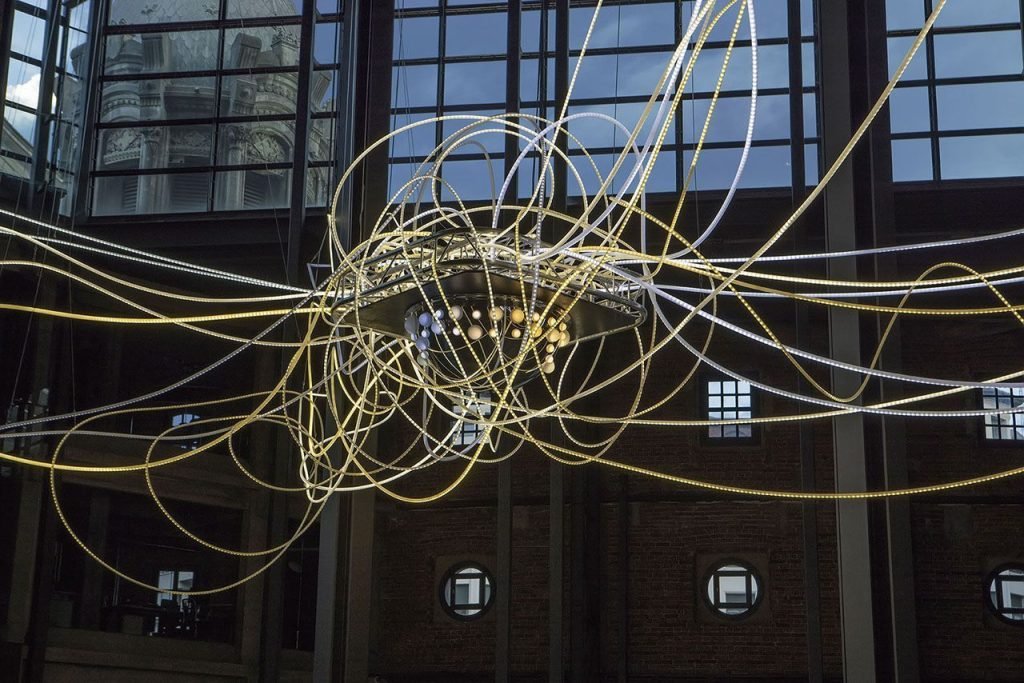
SCIENTIA, Grimanesa’s work for the Wellbeing Summit in Bilbao, is a monumental, site-specific light sculpture that will be installed at the Atrium of Azkuna Zentroa, opening for the Summit and remaining in place throughout the summer of 2022.

Location: Azkuna Zentroa – Atrium
OPEN TO THE PUBLIC
Date: May 31 – August 30
Time: 9am – 9pm

Creating monumental sculptures often makes Amorós consider how our environment affects our state of mind and well-being. Her new site-specific light sculpture SCIENTIA will engage visitors in a dialogue with the surrounding architecture and community, encouraging moments of self-reflection and personal realization while simultaneously creating connection through the medium of light.

The project’s name SCIENTIA is a Latin word meaning knowledge and knowing, experience and expertise, but going beyond a personal understanding. The word implies a socially interactive activity, the seeking and sharing of knowledge. This artwork will explore the human connection using our elemental knowledge of the world: fire, water, earth, and light. Through this primordial immersion, SCIENTIA provides a means of accessing our emotional selves within a manifested mental space that nurtures well-being and promotes community engagement.

Grimanesa Amorós was born in Lima, Peru, and lives and works in New York City. She is an interdisciplinary artist whose diverse interests include social history, scientific research, and critical theory. A direct relationship to technology is one of the distinctive features of Amorós’ practice. Her works incorporate video, lighting, and technological elements to create monumental sculptures involving architecture and engaging communities.

ESPAÑOL ESPAÑOL

SCIENTIA, la obra de Grimanesa para The Wellbeing Summit, es una escultura de luz monumental y específica para el lugar que se instalará en el Azkuna Zentroa, que se inaugurará para la Cumbre y permanecerá en el lugar durante todo el verano de 2022.

La creación de esculturas monumentales hace que Amorós se plantee a menudo cómo nuestro entorno afecta nuestro estado de ánimo y bienestar. Su nueva escultura lumínica SCIENTIA, específica para el lugar, hará que los visitantes entablen un diálogo con la arquitectura y la comunidad circundantes, fomentando momentos de autorreflexión y realización personal y creando al mismo tiempo una conexión a través del medio de la luz.

El nombre del proyecto, SCIENTIA, es una palabra latina que significa conocimiento y saber, experiencia y pericia, pero que va más allá de la comprensión personal. La palabra implica una actividad socialmente interactiva, la búsqueda y el intercambio de conocimientos. Esta obra de arte explorará la conexión humana utilizando nuestro conocimiento elemental del mundo: fuego, agua, tierra y luz. A través de esta inmersión primordial, SCIENTIA proporciona un medio para acceder a nuestro yo emocional dentro de un espacio mental manifiesto que nutre el bienestar y promueve el compromiso de la comunidad.

Grimanesa Amorós nació en Lima, Perú, y vive y trabaja en Nueva York. Es una artista interdisciplinar cuyos diversos intereses incluyen la historia social, la investigación científica y la teoría crítica. La relación directa con la tecnología es uno de los rasgos distintivos de la práctica de Amorós. Sus obras incorporan vídeo, iluminación y elementos tecnológicos para crear esculturas monumentales que implican a la arquitectura y comprometen a las comunidades.
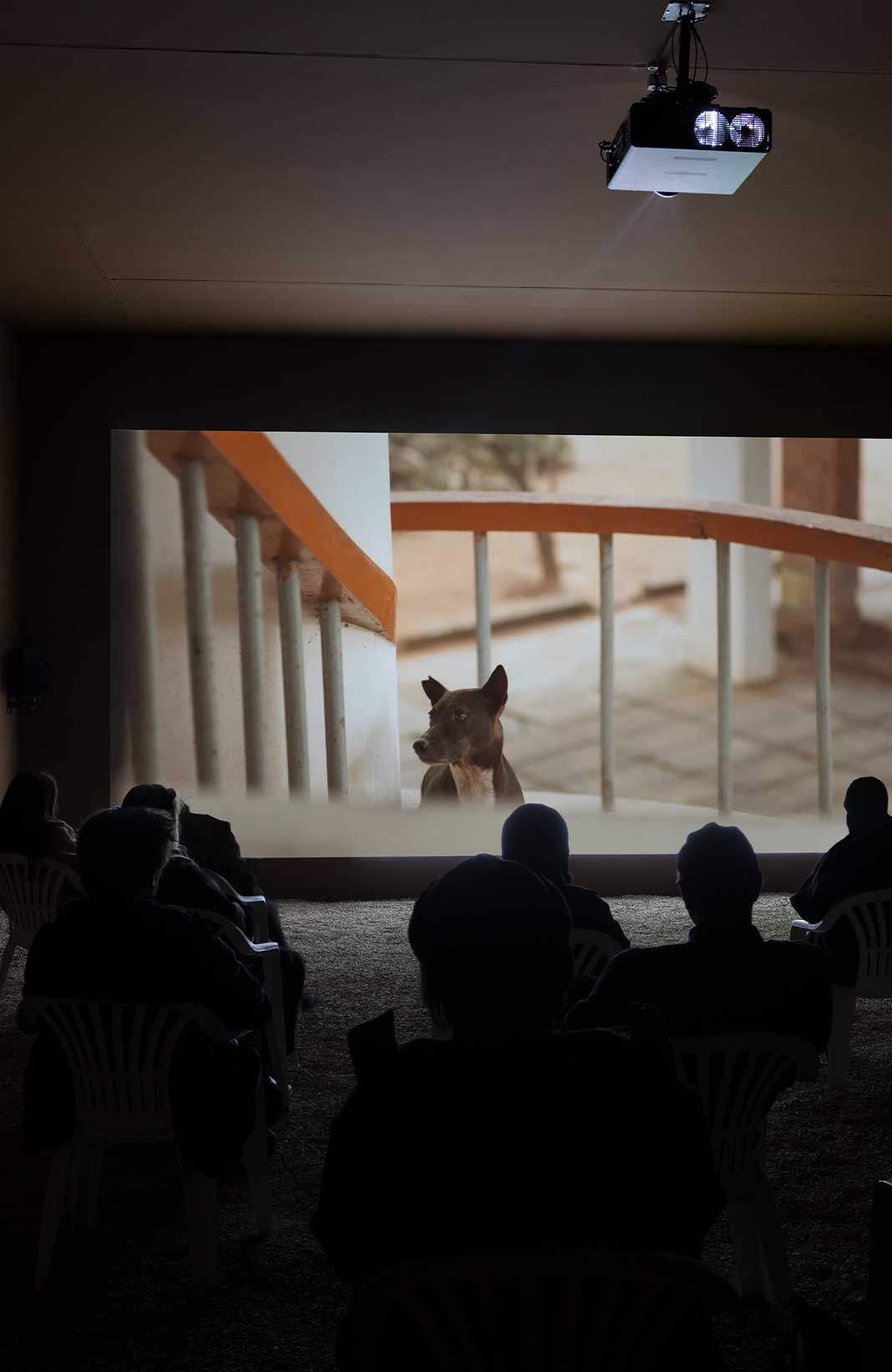
Filmed at the Institute of Fine Arts of Dhaka, Bangladesh, and shown at The Wellbeing Summit for Social Change, Daniel’s Fog Dog follows the daily and nightly activities of a group of stray dogs that live in the school.

Location: Guggenheim Bilbao
OPEN TO THE PUBLIC
Date: June 1 – June 3

Time: 11am – 7pm

The building was designed by pioneering Bangladeshi architect Muzharul Islam (1923-2012) and is characterized by the organic relationship between its interior and the surrounding green urban spaces. The dogs’ daily existence connects with many presences and signs – students and guardians, birdcalls and car horns, broadcasts, and spiritual entities – which coexist more and less harmonically with one another. The film is an exploration of interdependencies and how our attitudes affect everyone else – as such, it is a vivid and compelling commentary on the interconnected nature of collective Wellbeing.

Born in Barcelona, Daniel Steegman lives and works in Rio de Janeiro. From drawing to film, passing through
sculpture, installation and landscape interventions, Daniel Steegmann Mangrane’s work questions our relationship to the environment and invites the viewer to be physically involved in his projections and displacements. His video pieces and installations engage with the imagination of the spectator and often traces the boundary where nature meets artifice.

Daniel’s recent solo shows include Dog Eye, Kunsthalle Münster, Münster, Germany (2020); A Leaf-Shaped Animal Draws The Hand, Pirelli HangarBicocca, Milan (2019); Ne voulais prendre ni forme, ni chair, ni matière, Institut d’Art Contemporain de Villeurbanne, Villeurbanne (2019). His work has been also featured at the group shows Liverpool Biennial (2021); Taipei Biennial (2020); Concrete Contemporary, Museum Haus Konstruktiv, Zürich (2019).

ESPAÑOL

Filmada en el Instituto de Bellas Artes de Dhaka, Bangladés; Fog Dog de Daniel Steegmann Mangrané sigue las actividades diurnas y nocturnas de un grupo de perros callejeros que viven en la facultad.

El edificio fue diseñado por el pionero arquitecto bangladés Muzharul Islam (1923-2012) y se caracteriza por su orgánica relación entre su interior y los espacios verdes urbanos que lo rodean. La existencia diaria de los perros conecta con muchas presencias y señales (alumnos y guardianes, cantos de pájaros, bocinas de coches, emisiones y entidades espirituales) que coexisten más o menos armónicamente entre sí.

La película es una exploración de las interdependencias y como las actitudes afectan a todos los demás; como tal es un comentario vívido y convincente sobre la naturaleza interconectada del bienestar colectivo.

Nacido en Barcelona, Daniel Steegman vive y trabaja en Río de Janeiro. Desde dibujar, hasta filmar, pasando a través de esculturas e instalación e intervenciones paisajísticas, el trabajo de Daniel Steegmann Mangrane cuestiona nuestra relación con el ambiente e invita al espectador a estar envuelto físicamente en sus proyecciones y desplazamientos. Sus piezas de video e instalaciones conectan con la imaginación del espectador y traza la barrera donde la naturaleza se encuentra con el artificio.

Entre sus obras en solitario más recientes se encuentran: Dog Eye, Kunsthalle Münster, Münster, Alemania (2020); A Leaf-Shaped Animal Draws The Hand, Pirelli HangarBicocca, Milán (2019); Ne voulais prendre ni forme, ni chair, ni matière, Instituto de Arte Contemporáneo de Villeurbanne, Villeurbanne (2019). Sus obras también ha sido publicadas en exhibiciones grupales: Liverpool Biennial (2021); Taipei Biennial (2020); Concrete Contemporary, Museum Haus Konstruktiv, Zúrich (2019).